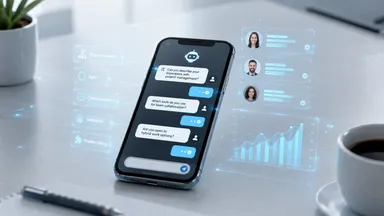
Smart Matching has shifted from being a nice-to-have to a baseline requirement for any hiring process that aims to scale without losing quality. When a single job offer attracts thousands of applications, the human eye simply cannot keep up. SofIA, the proprietary AI built by Leeters, was designed to close that gap: it compares CV and job offer against objective criteria, reduces bias and hands the recruiter a coherent shortlist. In this article I cover how it works and why it outperforms traditional keyword search.
Unlike a keyword filter, Smart Matching reads an application as a whole. SofIA doesn't look for the word "Java" inside a CV: it interprets the candidate's career path, the real responsibilities behind each role and the context in which they took shape. That is what lets it prioritise profiles a traditional system would discard for using different terminology.
In practice, the SofIA AI platform cross-checks three layers in every match:
- Technical fit: experience, tooling, certifications and sector trajectory.
- Functional fit: type of responsibilities, size of teams managed, level of autonomy.
- Cultural fit: signals around values, working pace and motivation drawn from the CV itself and the chatbot interaction.
This combined reading is what produces a match score the recruiter can understand and, more importantly, defend in front of the client.
Boolean search is still useful, but it has a ceiling. If a job offer asks for a "Full Stack Developer" and a candidate writes "Web developer · React + Node", they will probably be filtered out. Smart Matching avoids that kind of label-based rejection and prioritises semantic equivalence.
"The difference isn't about filtering faster — it's about filtering better. When a process discards strong candidates because of a misspelled word, what's lost isn't CVs: it's hires."
— Sergio Lucas Ocaña, CEO of Leeters
At scale, that vocabulary bias translates into incomplete shortlists and inflated time-to-hire. Smart Matching tackles the issue at the root.
A legitimate concern around AI in hiring is bias. SofIA is built to keep bias below 1%, complying with GDPR and the EU AI Act, and audited by ECIJA. The match is not decided by name, photo, age or gender, but by the objective signals each candidate provides.
This compliance layer is not decorative: in sectors with high turnover or high-volume processes, a poorly calibrated AI can amplify problems instead of solving them. Continuous auditing is what keeps the matching clean.
Smart Matching does not work in isolation. In a real Leeters process it is combined with:
- Conversational chatbot that screens the candidate in their own language (SofIA supports more than 50).
- AI video interview analysis, which adds signals around communication and soft skills.
- Automated shortlist generation the recruiter reviews and enriches with their own judgement.
The shortlist reaches the client with solid data behind it, not a dressed-up intuition. The recruiter spends time on what really adds value: understanding the client's business and getting to know the final candidates in depth.
Smart Matching shines when volume is high and criteria change fast. Retail, logistics, contact centres, hospitality and restaurants run seasonal campaigns where hundreds of positions need to be filled in a few weeks. In these contexts, our RPO and SaaS model lets companies absorb peaks without building a disproportionate internal team.
For highly specialised technical roles, matching helps in the opposite direction: finding the few valid candidates inside an enormous pool of seemingly similar CVs.
Smart Matching does not replace the recruiter; it equips them. It saves up to 70% of screening time so the recruiter can spend more energy on the conversation, on understanding the candidate and on presenting the case to the client. AI brings consistency; the recruiter brings context.
If your team is stuck at the first filter and you want to see what happens when Smart Matching is applied to your real pipeline, request a demo and we'll set up a test using one of your own offers.